If you’re choosing your first credit card — or trying to figure out if you’re leaving money on the table with your current one — you’ve probably run into two competing terms: rewards cards and cashback cards. They sound like they’re describing the same thing, and technically, cashback is a type of rewards. But the two get marketed so differently that most people never actually compare them side by side.
This guide breaks down exactly how each one earns you money, which one wins for different spending habits, and how to avoid the mistake that costs new cardholders the most: picking a card based on the sign-up bonus instead of how you actually spend.
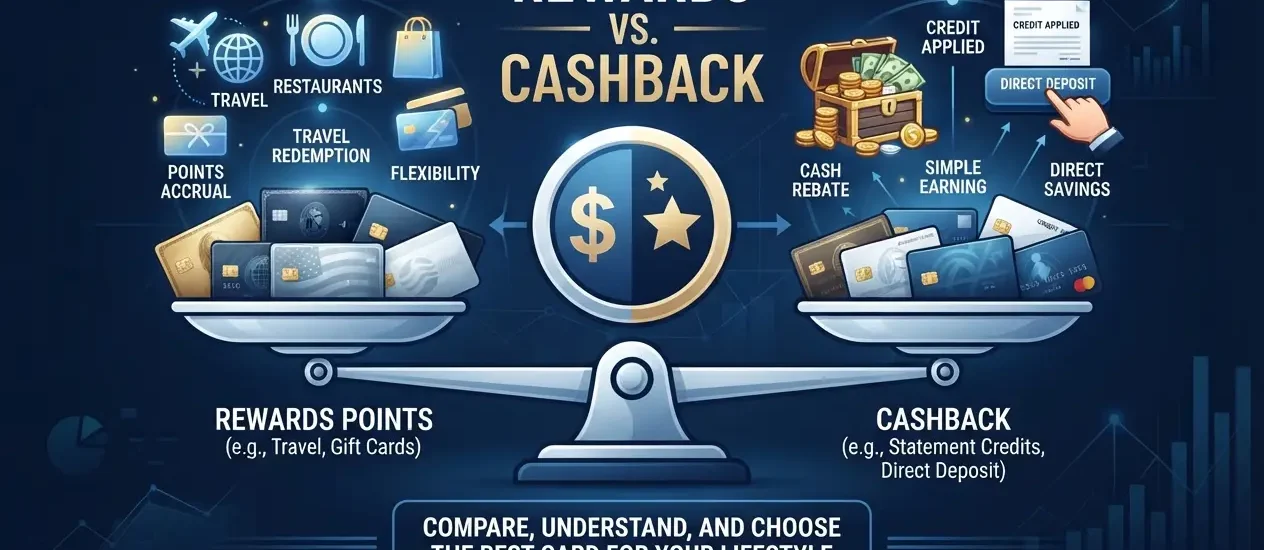
Every cashback card is a rewards card, but not every rewards card gives you cashback.
Cashback cards convert your spending directly into dollars — usually a flat percentage back, deposited as a statement credit, bank transfer, or check. There’s no math, no point valuation, no guessing what a “point” is worth. $1 spent might earn you $0.02 back. Simple.
Rewards cards (in the narrower sense marketers use) usually mean travel or points-based cards — think airline miles, hotel points, or transferable currencies like Chase Ultimate Rewards or Amex Membership Rewards. These points aren’t worth a fixed amount. Depending on how you redeem them, a point could be worth anywhere from 0.5 cents to over 2 cents.
The trade-off is straightforward: cashback is simpler and more predictable, while points-based rewards can be worth significantly more — but only if you’re willing to put in the work to redeem them well (booking travel strategically, transferring to partner programs, etc.).
Cashback cards fall into three main structures, and understanding which one fits your spending is the single biggest factor in how much you’ll actually earn back each year.
These pay the same percentage on every purchase, no categories to track. Typical flat rates on well-known cards land around 1.5% to 2% on everything. The appeal is zero effort — you don’t need to remember which category is active this quarter or cap your spending to hit a bonus rate.
Best for: People who want one card for everything and don’t want to think about optimizing.
These offer a higher rate (often 3% to 6%) in specific spending categories — groceries, dining, gas, streaming — and a lower flat rate (typically 1%) on everything else. Some cards let you pick your own bonus categories each quarter; others fix them permanently.
Best for: People whose spending is concentrated in one or two categories, like heavy grocery or dining spend.
These offer an elevated rate (commonly around 5%) on categories that change every quarter — think groceries in Q1, gas stations in Q2, and so on — usually up to a spending cap, with a lower flat rate outside those categories. You typically have to manually activate the bonus category each quarter or you default to the lower rate.
Best for: Highly engaged users willing to track category changes and activate bonuses on time. If you forget to activate, you lose the higher rate entirely — which is the most common way people underuse these cards.
This is the question that actually matters, and the honest answer is: it depends on your redemption habits.
The catch is that squeezing that extra value out of points takes research, flexibility on travel dates, and a willingness to deal with more complexity. If that’s not you, a straightforward cashback card will almost always be the higher-value choice in practice, simply because you’ll actually use the rewards instead of letting points expire unused.
Before comparing specific cards, map out where your money actually goes. Pull up your last two or three months of bank or card statements and total your spending by category — groceries, dining, gas, subscriptions, everything else. This single step determines whether a flat-rate or bonus-category card will actually earn you more.
A rough framework:
Chasing sign-up bonuses over long-term earn rates. A $200 welcome bonus feels great on day one, but if the card’s ongoing earn rate doesn’t match your spending, you’ll come out behind within a year or two.
Forgetting to activate rotating categories. This is the single biggest reason people underperform on rotating cashback cards — missing the quarterly activation often means dropping to a 1% rate for that entire quarter.
Carrying a balance. Cashback and rewards are calculated on spending, not on what you owe. Carrying a balance means paying interest that will outweigh any cashback earned many times over. These cards only make financial sense if you’re paying your statement balance in full every month.
Ignoring annual fees relative to actual spend. A card with an annual fee can still be worth it if your spending in its bonus categories comfortably clears the fee — but it’s easy to overestimate how much you’ll actually spend in a given category. Do the math against your real numbers, not an optimistic guess.
Not checking redemption minimums or expiration rules. Some cards require a minimum balance before you can redeem cashback, or let unused rewards expire after a period of inactivity. Read the redemption terms before applying, not after your first missed cycle.
| Cashback Cards | Points/Travel Rewards Cards | |
|---|---|---|
| Value predictability | Fixed, always know exact dollar value | Variable, depends on redemption method |
| Effort to maximize | Low to moderate | Moderate to high |
| Best redemption | Statement credit, bank deposit | Travel bookings, partner transfers |
| Typical earn rate | 1.5%–2% flat, 3%–6% bonus categories | Similar cash value unless redeemed for travel |
| Best for | Simplicity, guaranteed value | Frequent travelers willing to optimize |
Q: Are rewards cards better than cashback cards?
Rewards cards can provide higher value, especially for travelers, but cashback cards are simpler and often better for average spending.
Q: Can I have both card types?
Yes, Many Americans use multiple cards to maximize benefits.
For example:
Q: Do rewards affect taxes?
Generally, credit card rewards are treated as rebates rather than taxable income, but specific situations may vary.