If you’ve spent any time browsing your 401(k) options or opening a brokerage account, you’ve probably run into these three terms and wondered if they’re basically the same thing wearing different hats. They’re not. And picking the wrong one for your situation can quietly cost you thousands of dollars over a few decades, mostly through fees you never noticed.
Here’s the short version before we get into the weeds: an index fund is a strategy (tracking a market index instead of trying to beat it), while ETF and mutual fund are structures — the wrapper the investment comes in. So the real comparison isn’t a clean three-way fight. It’s ETF vs. mutual fund as structures, and then index vs. actively managed as a strategy that can live inside either one. Once that clicks, the rest of this gets a lot easier.
Let’s break down what each one actually is, how they differ where it counts, and how to decide which combination makes sense for you.
A mutual fund pools money from a large group of investors and uses it to buy a basket of stocks, bonds, or other assets. You don’t buy mutual fund shares on a stock exchange during the day. Instead, you place an order, and it gets filled once, after the market closes, at a price called the Net Asset Value (NAV).
Mutual funds come in two flavors:
Most people’s first exposure to mutual funds is through a workplace retirement plan, since 401(k) menus have historically leaned heavily on mutual funds rather than ETFs.
An ETF, or exchange-traded fund, also pools investor money into a basket of assets. The difference shows up in how you buy and sell it. ETFs trade on a stock exchange all day long, just like an individual stock. The price moves in real time based on supply and demand. You can buy as little as one share, and many platforms now let you buy a fraction of one.
Like mutual funds, ETFs can be actively managed or index-based. Most ETFs on the market today track an index, though. That’s why people often use “ETF” and “index fund” interchangeably, even though they aren’t technically the same thing.
An index fund isn’t really a separate product category. It’s an approach. The fund builds itself to match the performance of a specific market benchmark, like the S&P 500, the Nasdaq-100, or the total U.S. stock market. It does this by holding the same securities in roughly the same proportions as that index.
No stock-picking happens here. No one tries to time the market. The fund manager’s job is simply to replicate the index as closely and cheaply as possible. This passive approach explains why index funds tend to charge such low fees compared to actively managed funds.
You can structure an index fund as either a mutual fund or an ETF. Take Vanguard’s total stock market index fund as an example. You can buy it as a mutual fund (VTSAX) or as an ETF (VTI). Both track the same index and hold nearly identical securities.
This is where most people get tripped up. Let’s go through it point by point.
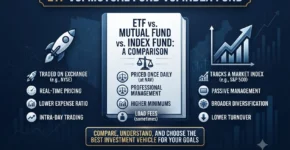
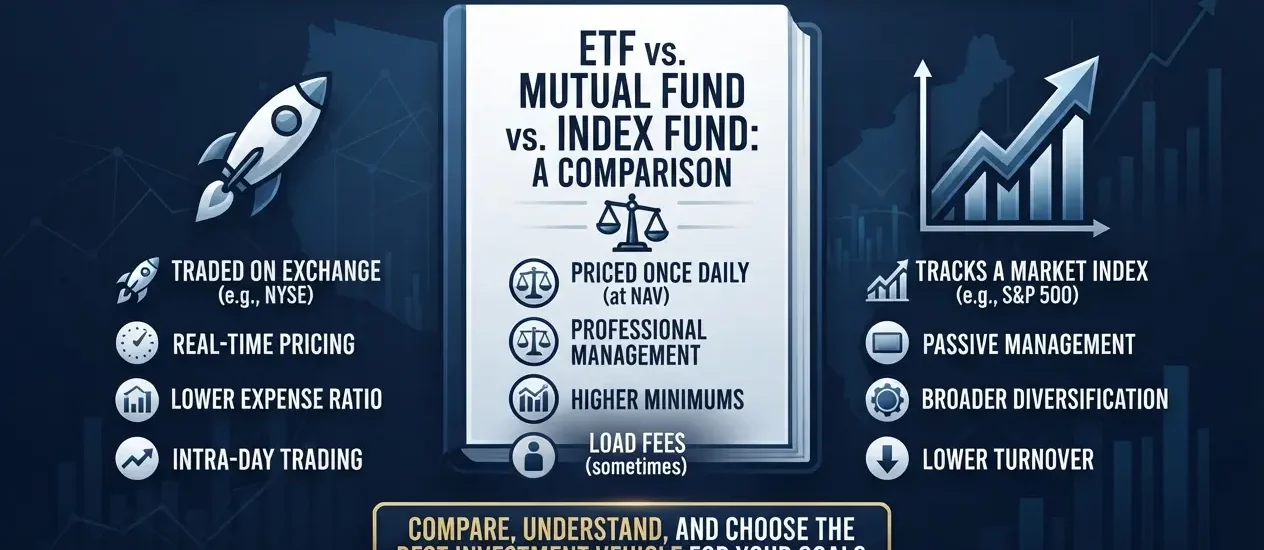
Mutual funds price once per day, after market close. ETFs price continuously throughout the trading day. Do you want to buy at a specific price? Do you want the flexibility of limit orders or stop-losses? Only an ETF gives you that.
Many mutual funds set a minimum investment to get started. That minimum might run $1,000, $3,000, or more, depending on the fund company. ETFs typically carry no minimum beyond the price of a single share. Fractional share investing has made even that a non-issue on most modern platforms.
This explains a lot of the ETF boom over the last decade. Most ETFs track an index and skip active management, so their expense ratios tend to run lower than actively managed mutual funds. But compare an index mutual fund to an index ETF tracking the same benchmark, and the fee gap mostly closes. Both can now run well under 0.10% annually with major providers.
Here’s a difference people don’t talk about enough. ETFs generally hold a structural tax advantage over mutual funds. This comes from how shares get created and redeemed behind the scenes, through a process called “in-kind” transfers, which avoids triggering capital gains. Mutual funds, especially actively managed ones, distribute capital gains to shareholders more often. That means you might owe a tax bill even if you never sold a single share. This matters in a taxable brokerage account. It doesn’t matter inside a 401(k) or IRA, since those accounts already carry tax advantages.
Do you like setting up an automatic transfer every payday? Mutual funds have historically made this easy. Most brokerages let you dollar-cost average into mutual funds automatically, buying partial shares without any hassle. ETFs have caught up here too, especially with fractional shares. But not every broker supports automatic recurring ETF purchases yet.
| Feature | ETF | Mutual Fund | Index Fund (Strategy) |
|---|---|---|---|
| Structure type | Trading vehicle | Trading vehicle | Investment strategy |
| Can be actively managed | Yes (less common) | Yes (common) | No, by definition |
| Can track an index | Yes (most common) | Yes | Always |
| Trades during market hours | Yes | No, priced once daily | Depends on wrapper |
| Typical minimum investment | Price of 1 share (or fractional) | Often $1,000+ | Depends on wrapper |
| Expense ratios (index version) | Very low | Very low | Very low |
| Tax efficiency | Generally higher | Generally lower | Depends on wrapper |
| Best for automatic recurring buys | Improving, not universal | Very easy | Depends on wrapper |
| Where you’ll find it | Brokerage accounts | 401(k)s, brokerage accounts | Both |
There’s no single right answer here. But a few patterns hold up consistently.
Investing through your employer’s 401(k)? You probably won’t get much choice between ETF and mutual fund, since most plans stick to mutual funds. You can still choose the index fund option over the actively managed one, though, and that choice usually matters more for your fees.
Investing in a taxable brokerage account? An index ETF is generally the more tax-efficient pick. This holds especially true if you’re investing a lump sum or don’t need small recurring purchases.
Want to dollar-cost average small amounts every week or month? A mutual fund makes this easier logistically. Or use a broker that supports automatic fractional ETF purchases.
Are you a beginner who just wants simple, low-cost, diversified market exposure? Choose an index fund, in either wrapper. It beats picking individual stocks or chasing an actively managed fund’s past performance. Past performance, by the way, has a well-documented habit of not repeating itself.
A few things trip up even experienced investors:
Think of it this way. Index vs. active answers a question about strategy. ETF vs. mutual fund answers a question about structure. Most long-term investors do best with index strategies. The choice between ETF and mutual fund wrapper usually comes down to where you invest (401(k) vs. brokerage), how you like to buy (lump sum vs. recurring small amounts), and how much you care about tax efficiency.
For most people building long-term wealth, either an index mutual fund or an index ETF tracking a broad market benchmark gets the job done. Just keep the fees low, and stay invested through the ups and downs.
Q: Is an ETF better than a mutual fund?
Neither wins universally. ETFs tend to offer more trading flexibility, lower minimums, and better tax efficiency in taxable accounts. Mutual funds tend to work better for automatic recurring investments and show up more often in 401(k) plans. The better choice depends on your account type and investing habits.
Q: Is an index fund the same as an ETF?
No. An index fund is a strategy that tracks a market benchmark. An ETF is a trading structure. You can build an index fund as either an ETF or a mutual fund.
Q:Which has lower fees, ETFs or mutual funds?
Compare actively managed mutual funds to ETFs, and ETFs usually win on fees. But compare an index mutual fund to an index ETF tracking the same benchmark, and the fee difference often shrinks to almost nothing.
Q:Can I lose money in an index fund?
Yes. Index funds still track the market, and markets go down as well as up. Index funds reduce your risk of underperforming the market due to poor active management. They don’t reduce market risk itself.
Q:Are ETFs riskier than mutual funds?
Not inherently. Risk depends on what the fund holds, not the wrapper it comes in. An index ETF tracking the S&P 500 carries essentially the same risk profile as an index mutual fund tracking the same benchmark.