Let’s be entirely honest: traditional financial advice is broken. For years, we’ve been told that if we just gave up our daily latte or cut out that streaming subscription, we would magically buy a house and secure our financial future. But in 2026, Americans are facing a completely different economic reality.
With grocery prices remaining stubbornly high, housing costs testing everyone’s patience, and the national personal saving rate hovering at a historic low of around 3.6%, managing money isn’t as simple as skipping a coffee. It’s hard out there. If you feel like your paycheck isn’t stretching as far as it used to, you aren’t failing—you are simply navigating a high-cost economy that requires a more realistic approach.
The secret to financial peace of mind right now isn’t total deprivation. It’s about building sustainable, automated habits that allow you to handle the essentials, save for the future, and still enjoy your life today. Here are the most practical, real-world tips how to manage money effectively this year.
The 2026 Reality Check: According to recent consumer wellness data, over 60% of US households cite money as their primary daily stressor. True wealth management is no longer about rigid restriction; it is about building a personal safety net that gives you room to breathe.
Most traditional budgets fail because they act like crash diets. You restrict your spending so severely for three weeks that by week four, you suffer from financial exhaustion, give up, and splurging follows.
Instead of tracking every single penny down to the cent, switch to a mindful spending framework. A classic, flexible model that works incredibly well for the US cost of living is the 50/30/20 rule:
The beauty of this framework is its flexibility. If your rent takes up 55% of your income due to high housing costs in your city, you don’t panic; you simply adjust your wants down to 25% to keep your financial health balanced.
If the last few years have taught us anything, it’s that life loves throwing unexpected curveballs. A sudden medical bill, a major car repair, or an unexpected gap in employment can completely derail your progress if you aren’t prepared. Yet, nearly 30% of Americans have more credit card debt than emergency savings.
The absolute fastest way to build an emergency fund is to remove human willpower from the equation. Automate it. Set up your direct deposit at work to send a small, fixed percentage of every paycheck (even if it’s just $25 or $50) straight into a separate savings account.
Where you keep your emergency fund matters immensely. Traditional brick-and-mortar US banks are notorious for paying a miserable 0.01% interest on standard savings accounts. That means your money is actively losing purchasing power to inflation.
Instead, open a dedicated High-Yield Savings Account (HYSA) with an insured online bank. Online banks don’t have the overhead costs of physical branches, so they pass those savings on to you in the form of significantly higher interest rates. Your money will grow just by sitting there. Aim to secure a $1,000 baseline buffer as quickly as possible, then gradually build it out until it covers 3 to 6 months of your living expenses.
Carrying a balance on credit cards is one of the heaviest financial anchors holding Americans back. With average credit card APRs sitting well above 20%, high-interest debt compounds quickly, eating away at your disposable income.
To break free, you need a systematic strategy. The two most effective, time-tested methods in the US are the Debt Avalanche and the Debt Snowball.
| Strategy | Focus Factor | Best Suited For |
| The Debt Avalanche | Mathematical Efficiency: You list your debts from highest interest rate to lowest. You pay the bare minimums on all accounts except the one with the highest APR, throwing every extra dollar at that balance first. | Analytical thinkers who want to minimize the total amount of interest paid over time. |
| The Debt Snowball | Psychological Momentum: You list your debts from the smallest balance to the largest, regardless of interest rates. You attack the smallest balance first to wipe it out completely, then roll that payment into the next smallest. | Anyone who needs fast, tangible visual wins to stay motivated and committed to the journey. |
Pick the strategy that aligns best with your personality. The “right” method is simply the one you will actually stick with until your balances hit zero.
You don’t need an advanced degree in finance to start growing long-term wealth; you just need to utilize the institutional guardrails already built into the US financial system.
If your employer offers a 401(k) matching program, contributing to it should be your absolute top financial priority. If a company matches your contributions up to 4%, and you choose not to participate, you are quite literally leaving free money on the table. It is an instant, 100% return on your investment before the money even hits the market.
Beyond your workplace, look into opening an Individual Retirement Account (IRA) through a brokerage.
For younger professionals or those who expect to be in a higher tax bracket later in life, the Roth IRA is often a massive favorite.
Because almost every modern service has shifted to a subscription model, it is incredibly easy to experience “subscription creep.” We sign up for a free trial for a streaming service, an app, a gym membership, or a delivery pass, and entirely forget about it. The average American underestimates their monthly subscription spending by hundreds of dollars.
Set a timer on your phone for 15 minutes this weekend and log into your primary checking and credit card accounts. Go through the last 60 days of statements line by line and look for the hidden leaks.
If you find streaming platforms you haven’t watched in a month, cancel them. You can always resubscribe later when a new season of your favorite show drops. Try implementing the “one-in, one-out” rule for entertainment apps to keep your fixed monthly costs lean.
Learning how to manage money isn’t just about accumulation and growth; it’s also about playing smart defense. A single medical emergency, a minor car accident, or a disaster at home can instantly wipe out years of disciplined savings if you are underinsured.
Take the time annually to review your core insurance policies:
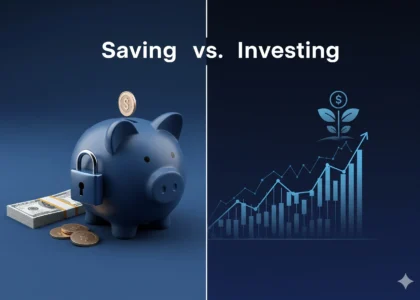
A safe rule of thumb is to keep roughly 1 to 2 months’ worth of living expenses in your checking account to handle your regular bills and prevent any accidental overdrafts. Any cash beyond that buffer should be moved out into a high-yield savings account or an investment portfolio so it can actively earn interest.
If you have high-interest debt (like credit card balances with an APR higher than 10%), you should prioritize paying it off, as that interest rate outpaces the historical returns of saving or investing. However, you should still build a small $1,000 emergency fund before aggressively tackling the debt so you don’t have to swipe your card again if an unexpected expense pops up.
While the national average often fluctuates under 4% due to economic pressures, a healthy personal target to shoot for is 10% to 20% of your take-home pay. If that feels impossible right now, start at 1% or 2% and increase it by just 1% every six months. Small steps compound dramatically over time.
Mastering your money in 2026 isn’t about achieving absolute perfection, and it certainly shouldn’t mean making your daily life miserable. It’s about control, awareness, and consistency. By setting up automated systems to fund your high-yield savings account, choosing a structured path out of high-interest debt, and protecting your income with smart accounts, you take the emotion and stress out of money management. Give yourself some grace as you navigate this economy, implement these changes incrementally, and watch your financial confidence grow.