Saving and investing are both essential for financial health—but they serve different goals. Saving protects short-term needs and emergencies; investing grows wealth for long-term goals by accepting risk. This article explains the differences, when to use each, real-world comparisons, practical strategies, tax considerations, and an action plan you can start today.
Introduction — why this matters
A lot of folks mix up saving and investing, and that mix-up can really cost you. If you tuck your money away in a low-interest savings account for a goal that’s ten years down the line, inflation can chip away at what that money can actually buy. On the flip side, if you decide to invest in stocks for something like an emergency fund, you might find yourself facing some ups and downs just when you need cash the most. Understanding when to save and when to invest is key to handling your short-term needs while also building your wealth for the long haul.
Fundamental differences
1. Purpose
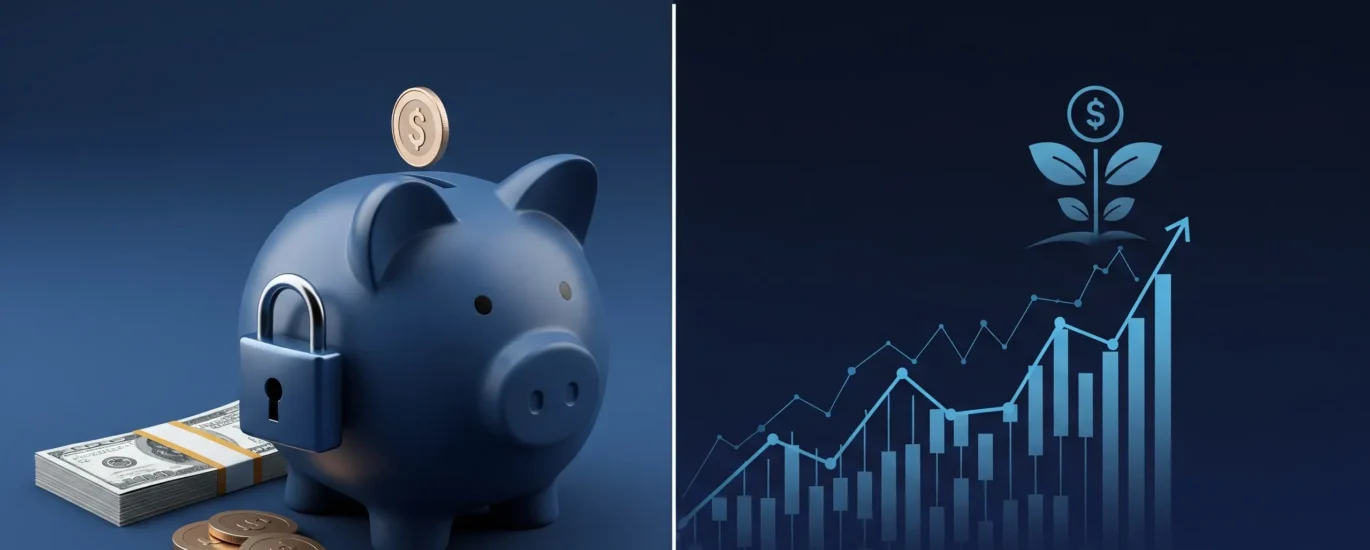
- Saving: It is all about short-term safety and liquidity. Think of it as your go-to for things like an emergency fund, upcoming bills, or those short-term purchases like a vacation or a new laptop.
- Investing: Investing, on the other hand, is geared towards long-term growth. This is where you’d look at things like retirement savings, a down payment in 5 to 15 years, or building your wealth over time.
2. Risk & return
- Saving: When it comes to saving, you’re looking at low risk and low return. Your principal is pretty safe, especially if it’s backed by a government program or bank insurance.
- Investing: Investing carries a higher risk but also the potential for higher returns. The value of your investments can go up and down, but the idea is that the greater expected returns will make up for that risk.
3. Liquidity & time horizon
- Saving: Savings are highly liquid, The time horizon for savings typically ranges from just a few days to about three years.
- Investing: Investing is a bit different; it’s less liquid and can be more volatile. It’s best suited for a time horizon of five years or more, allowing you to ride out those market ups and downs.
4. Typical accounts & vehicles
- Saving vehicles: you might use high-yield savings accounts, money market accounts, short-term CDs, or cash management accounts
- Investing vehicles: When it comes to investing, you’d look at stock index funds or ETFs, bonds or bond funds, mutual funds, real estate, and retirement accounts like a 401(k) or IRA.
Real-world comparison (example)
Imagine you have ₹100,000 (or $1,200) and two goals:
- Emergency fund: ₹30,000 (3 months of expenses)
- Retirement in 30 years: remaining amount
Now, if you stash that emergency fund in a regular savings account with a meager 0.1% annual interest, you might find that its value shrinks over time due to inflation. Instead, consider putting that emergency fund into a high-yield savings account or a short-term investment that offers better rates while still keeping your money accessible.
For the retirement portion, think about investing in a diversified portfolio, like low-cost index funds. Historically, broad stock indexes have delivered better average returns over the long haul compared to just letting cash sit. Just keep in mind that while past performance can be a good indicator, it doesn’t guarantee what will happen in the future.
How Inflation Impacts Saving vs Investing
Inflation is one of the biggest factors to consider when deciding between saving and investing. Simply put, inflation reduces your money’s purchasing power over time. For example, if you keep cash in a regular savings account earning 0.5% interest while inflation is 3%, your money is effectively losing value each year.
- Saving and inflation: Savings accounts are safe but usually earn less than the inflation rate, which means long-term savers may face negative real returns. This is fine for short-term goals like emergency funds or upcoming expenses, where safety and liquidity matter most.
- Investing and inflation: Investments such as stocks, bonds, and index funds generally have the potential to outpace inflation over the long term. While short-term market fluctuations are normal, investing remains the most effective way to protect and grow your wealth against rising prices.
Saving vs Investing: Risk Tolerance and Time Horizon
Your decision to save or invest depends largely on risk tolerance (your comfort level with potential losses) and time horizon (how long you can leave the money untouched). Here’s a simple guide:
- Short-term horizon (under 3 years): If you’ll need the money soon, prioritize safety and liquidity. Use a high-yield savings account, money market account, or short-term CDs.
- Medium-term horizon (3–7 years): For goals a few years away, consider a balanced approach. Mix savings with low-risk investments like short-term bonds, conservative bond funds, or a CD ladder.
- Long-term horizon (7+ years): When you don’t need the money for a long time, investing is usually best. Focus on diversified portfolios of stocks, ETFs, or index funds, which have historically provided higher returns to outpace inflation.
Tax Considerations: Saving vs Investing
Taxes play a major role when comparing saving vs investing, and understanding the rules can help you keep more of your money.
- Savings accounts: The interest you earn from a savings account or CD is usually taxed as ordinary income. This means it is added to your annual taxable income and taxed at your regular income tax rate.
- Tax-advantaged investments: Retirement accounts such as 401(k)s, Traditional IRAs, and Roth IRAs offer significant tax benefits. A Traditional IRA or 401(k) allows you to contribute pre-tax dollars and reduce your taxable income today, while a Roth IRA lets your money grow tax-free with no taxes owed on qualified withdrawals.
- Capital gains and dividends: Investments in stocks, ETFs, or mutual funds may generate capital gains and dividends. Long-term capital gains (profits from assets held over one year) are generally taxed at a lower rate than short-term gains or ordinary income. This is why using tax-advantaged accounts for long-term investing can maximize returns.
Common Mistakes People Make in Saving vs Investing
Many beginners struggle with deciding how to balance saving and investing. Avoiding these common mistakes can save you money and stress:
- Using investments for emergencies: Markets fluctuate daily. If you put your emergency fund into stocks, you may be forced to sell at a loss when you suddenly need cash. Always keep your emergency savings in a liquid, low-risk account.
- Keeping long-term money in savings accounts: While safe, savings accounts earn low interest and often fail to beat inflation. Money meant for retirement or future wealth-building should be invested to grow over time.
- Not having an emergency fund: Skipping this step can lead to financial setbacks. Without a cash buffer, you might have to rely on credit cards or sell investments during a downturn.
- Trying to time the market: Many people attempt to “buy low, sell high,” but research shows that consistent strategies like dollar-cost averaging often perform better than emotional market timing.
Practical, step-by-step plan
- Start by building an emergency fund
- Aim to save enough to cover 3 to 6 months’ worth of essential expenses—consider saving more if your income is irregular or if you have dependents.
- Keep this money in a high-yield savings account, a money market account, or another short-term liquid option.
- Tackle high-interest debt
- Focus on paying off credit cards or payday loans first, as the interest rates on these can often be higher than what you’d earn from investments.
- Open retirement accounts
- Make sure to contribute enough to your 401(k) to snag any employer match. Also, look into maximizing tax-advantaged accounts like IRAs or Roth IRAs, depending on your eligibility.
- Create an investment strategy
- Decide on an asset allocation that fits your age, risk tolerance, and financial goals. For many, a straightforward and cost-effective choice is a core portfolio made up of broad-based index funds, such as a mix of total stock market, international stocks, and bonds.
- Automate contributions
- Set up automatic transfers into savings and investment accounts each payday.
- Review annually
- Take the time to rebalance your portfolio and reassess your goals, risk tolerance, and tax situation.
Where Should You Save vs Invest? (Quick Checklist)
Choosing the right place to put your money depends on your financial goals, time horizon, and risk tolerance. Here’s a simple guide:
Best Places to Save (Low Risk, Short-Term Goals)
If you need safe, accessible savings for emergencies or upcoming expenses, these are the best options:
- High-yield savings accounts: Earn higher interest than traditional savings while keeping money liquid.
- Short-term Certificates of Deposit (CDs): Lock in a fixed interest rate for a set period, ideal for short-term savings.
- Money market accounts or funds: Provide slightly higher returns than standard savings accounts with easy access.
- Cash management accounts: Offered by online brokers or fintechs, combining checking and saving features with competitive interest.
Best Places to Invest (Growth, Long-Term Goals)
For long-term wealth building, investing is essential. Here are the most effective vehicles:
- Broad-market index funds and ETFs: Low-cost, diversified investments tracking the overall stock market.
- Target-date funds: Simplify retirement investing by automatically adjusting risk based on your target retirement year.
- Tax-advantaged retirement accounts (401(k), IRA, Roth IRA): Grow your investments while reducing taxes.
- Fractional-share brokerage accounts: Allow you to invest in expensive stocks or ETFs with smaller amounts, perfect for beginners.
Frequently Asked Questions: Saving vs Investing
Q1: Should I save or invest first?
Most financial experts suggest that saving should come before investing. It’s a good idea to start by creating an emergency fund that covers 3 to 6 months of your expenses in a high-yield savings account. Once you have that safety net established and have tackled any high-interest debt, you can shift your focus to investing for long-term goals like retirement or building wealth.
Q2: What’s the main difference between saving and investing?
The primary distinction lies in risk versus reward. Saving is geared towards short-term goals and keeps your money safe and easily accessible, typically in a savings account or a certificate of deposit (CD). On the other hand, investing is aimed at long-term growth, utilizing assets such as stocks, bonds, and ETFs that come with higher risks but also the potential for greater returns.
Q3: How much money should I keep in savings?
A good rule of thumb is to keep 3–6 months of essential living expenses in savings. If you have an unstable income or dependents, aim for closer to 9–12 months for added security. This money should be kept in a safe, liquid account that you can access quickly during emergencies.
Q4: Is investing better than saving?
Neither is “better”—they serve different purposes. Saving is best for short-term goals and emergencies, while investing is better for long-term goals like retirement, buying a house, or building wealth. The smartest strategy is to use both: save for safety, invest for growth.
Q5: Where should beginners start investing?
Beginners typically find success with low-cost index funds or ETFs, which offer immediate diversification. If you’re in the U.S., opening a tax-advantaged account like a Roth IRA or 401(k) is also a smart choice. Always begin with money you won’t need in the near future, and keep your emergency savings separate.